The neuronal chromatin landscape in brains from individuals with schizophrenia is linked to early fetal development
Abstract
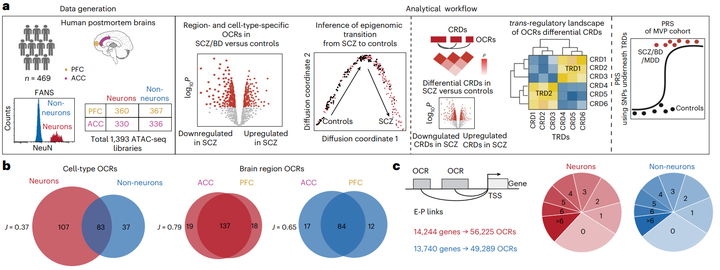
Noncoding variants increase neuropsychiatric disease risk, but our understanding of their cell-type-specific role remains incomplete. We conducted large-scale chromatin accessibility profiling of neurons and non-neurons from 2 neocortical regions in 1,393 libraries. We observed substantial differences in neuronal chromatin accessibility between schizophrenia (SCZ) cases and controls, with upregulated open chromatin regions (OCRs) in neurons associated with SCZ risk loci. A comparison of SCZ-associated OCRs with fetal brain-specific OCRs revealed a strong correlation between upregulated changes in SCZ chromatin and openness in fetal cortical brains, linking disease-related chromatin alterations to neurodevelopment. Here we show that a prominent neuronal trans-regulatory domain containing upregulated OCRs consolidates key neurodevelopmental chromatin signatures and is enriched for immature glutamatergic neurons. These findings link altered adult cortical chromatin states to early developmental mechanisms in SCZ. This study provides a comprehensive cell-type-resolved chromatin accessibility resource for the human cortex and offers insights into the regulatory architecture underlying SCZ risk.